
The AI Sales Co-Pilot: How Intelligent Agents Guide Reps Toward Better Outcomes
- RetailAI

- Mar 8
- 4 min read

Sales reps have always operated under pressure. Quota targets, short attention windows, and increasingly complex buying journeys leave little room for hesitation. Every conversation matters. Every follow-up needs to land at the right moment. Every message needs to say the right thing.
The problem is that human reps—however skilled—can only process so much information at once. They miss signals. They follow up too early or too late. They rely on intuition where data would serve them better.
This is precisely where the AI sales co-pilot changes the game.
Unlike automation tools that replace reps or chatbots that handle only surface-level queries, an AI sales co-pilot works alongside the human. It observes, analyses, and recommends—giving reps the intelligence they need to make sharper decisions in real time.
What Is an AI Sales Co-Pilot?
An AI sales co-pilot is an intelligent system that runs in parallel with a human sales rep throughout the sales cycle. It ingests data from CRM systems, communication tools, browsing behaviour, and engagement history to surface recommendations that the rep can act on immediately.
Think of it less as a tool and more as a second brain—one that never gets tired, never forgets a signal, and never loses track of where a prospect is in their buying journey.
Where a rep might remember what a prospect said in a call three weeks ago, the AI co-pilot remembers everything—and connects that to what they did on the website yesterday, which email they opened this morning, and what a similar buyer did just before they signed.
The Core Functions of an AI Sales Co-Pilot
1. Real-Time Contextual Guidance
During live calls or active conversations, an AI co-pilot can surface relevant content, competitor intel, or objection-handling strategies based on what's being discussed. Rather than scrambling for the right case study mid-call, the rep receives a prompt that says: 'This prospect matches the profile of buyers who responded well to X.'
This isn't about scripting conversations. It's about equipping reps with the right context at the exact moment it's needed.
2. Prioritisation and Next-Best-Action Recommendations
One of the most common sales failures isn't a bad pitch—it's poor timing. Reaching out when a prospect is distracted, or waiting too long after a buying signal, is quietly responsible for countless lost deals.
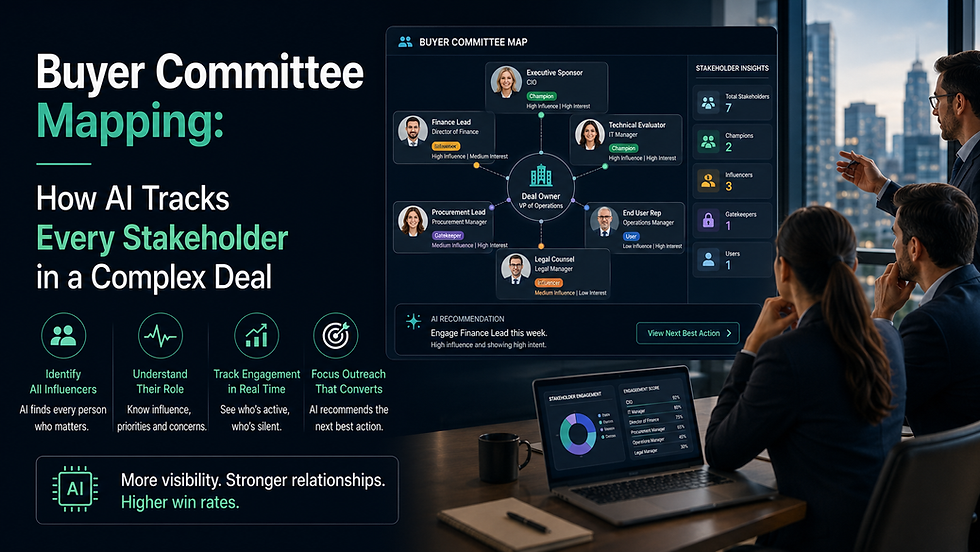
AI sales co-pilot systems continuously score prospects based on engagement signals, behavioural shifts, and pipeline stage. They surface who to contact next and, crucially, why. The rep doesn't have to guess. They act with confidence because the data supports the move.
3. Personalisation at Scale
Modern B2B buyers expect conversations that feel relevant to their specific situation. Generic outreach is tuned out almost immediately. AI co-pilots analyse what a prospect has read, watched, and engaged with, then help reps craft messages that resonate with that individual's context—without requiring hours of manual research.
This is personalisation that scales. The rep brings the relationship; the AI brings the intelligence.
4. Objection Prediction and Response Coaching
Experienced reps develop a sense for objections before they're raised. AI co-pilots systematise that intuition. By analysing patterns across thousands of past conversations, the system can identify which objections are likely at each stage of the deal—and suggest how to address them proactively.
This is particularly valuable for newer reps who haven't yet built the pattern recognition that comes with years of experience. The AI closes the experience gap.
5. Post-Call Intelligence and CRM Hygiene
Sales teams lose significant time logging notes, updating records, and trying to remember what was agreed on a call. AI co-pilots automate this layer—transcribing conversations, extracting commitments and action items, and pushing accurate updates to the CRM without rep effort.
The result is a cleaner pipeline, better forecasting, and more time for reps to sell rather than administrate.
Why Human Reps Still Matter
The AI sales co-pilot doesn't replace the rep. It amplifies them.
Buying decisions—especially in complex B2B environments—are still human. Trust, rapport, and the ability to navigate ambiguity in a live conversation are things AI supports but cannot replicate. What AI can do is remove the friction points that cause reps to underperform: information overload, poor timing, inconsistent follow-up, and the slow creep of admin work that erodes selling time.
The best sales teams of the next decade will not be the ones with the most reps. They will be the ones where every rep is operating with the best available intelligence at every step of the journey.
What High-Performance AI Co-Pilot Behaviour Looks Like
The difference between a basic sales tool and a genuine AI co-pilot comes down to how deeply it integrates with the rep's workflow. High-performance AI co-pilot behaviour includes:
Alerting reps when a prospect revisits a pricing or product page after a period of inactivity
Flagging when a deal has gone quiet for longer than the historical average for similar deals at the same stage
Surfacing competitive positioning material when a prospect mentions a rival product
Adjusting recommended follow-up cadence based on individual prospect responsiveness
Detecting sentiment shifts in email or chat exchanges that may signal concern or hesitation
The Impact on Sales Performance
Organisations that deploy AI sales co-pilot capabilities consistently report measurable improvements across key metrics:
Shorter sales cycles, because reps engage at peak intent moments rather than based on arbitrary schedules
Higher win rates, because personalisation and timing improve conversion at each stage of the funnel
Improved rep ramp time, because new reps benefit from AI-guided best practices from day one
Better pipeline accuracy, because AI-maintained CRM data reflects reality rather than rep memory
Conclusion
The shift to AI-assisted selling is not a future event—it is happening now. Sales organisations that treat AI as a co-pilot rather than a replacement tool are discovering that the combination of human relationship skills and machine intelligence is far more powerful than either alone.
The AI sales co-pilot doesn't remove the need for great salespeople. It makes great salespeople significantly better—and gives average salespeople a fighting chance of performing like their best colleagues.
In competitive markets, that edge is the difference.


Comments