
Sales Cycle Compression: How AI Reduces Time From Demo to Deal
- RetailAI

- 1 day ago
- 6 min read
Introduction
Time is the invisible cost of every sales cycle. It is not on the invoice. It does not appear in the CRM. But it is paid continuously — in the carrying cost of deals that should have closed already, in the revenue that was delayed rather than delivered, in the opportunities that expired while the deal was moving at a pace the buyer's organisation had long since outgrown.
Sales cycle length is the metric that organisations discuss least and should discuss most. A deal that takes six months to close when it could close in three is not a success delayed — it is a performance failure. And unlike most performance failures, it is often invisible: the deal is still in the pipeline, the rep is still working it, the forecast still shows it as an upcoming win. The cost of the additional ninety days is real but unaccounted for.
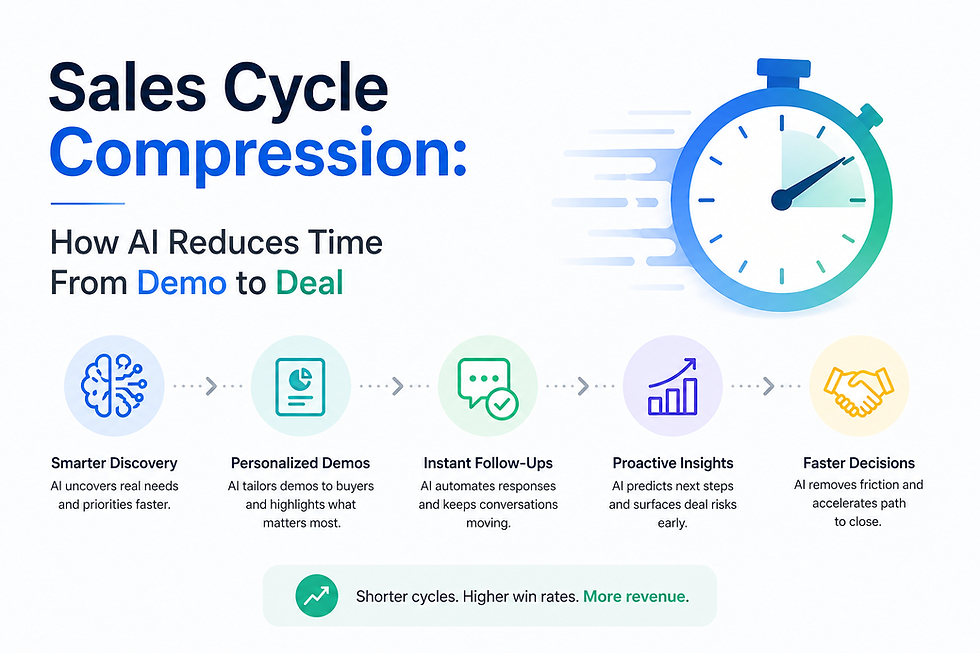
AI is changing sales cycle economics in ways that are both measurable and structural. Not by pressuring buyers to decide faster than their process allows — that approach fails and damages relationships — but by removing the latency that accumulates between meaningful buyer interactions. The wasted time in most sales cycles is not in the buyer's decision process. It is in the gaps between interactions: the time spent on research that could be automated, the follow-up sent too late because the signal was missed, the next step delayed because the rep was working the wrong deals in the wrong order. AI compresses these gaps — and the result is a shorter cycle that feels faster to the rep without feeling pressured to the buyer.
Where Time Is Lost in the Demo-to-Deal Journey
The post-demo phase is where sales cycles most commonly stall — and where the gap between a rep's intuition about deal health and the deal's actual trajectory is widest. The demo has been delivered. The prospect's response was positive. And then the cycle enters a period of apparent forward motion that is, in many cases, a sophisticated form of drift.
The Discovery Gap
Before a demo can be delivered effectively, discovery has to establish the context that makes the demo relevant. But discovery processes in most sales organisations are less structured than they appear. Key questions go unasked because the rep was focused elsewhere. Stakeholder priorities go unexplored because the discovery call ran long on the technical dimensions. The result is a demo that is competent but not precisely targeted — and a post-demo cycle that must do the discovery work that should already be complete.
AI accelerates the discovery phase by researching the account before the first human conversation, surfacing the publicly available information about the prospect's priorities, challenges, and competitive context that should inform the discovery conversation. The rep arrives at discovery already knowing what they need to confirm rather than starting from zero. Discovery becomes faster, denser, and more productive — and the demo that follows is sharper because of it.
The Follow-Up Latency Problem
The period immediately following a demo is the highest-momentum moment in the sales cycle. The prospect's interest is at its peak. The questions and objections raised in the demo are specific and actionable. The materials that would address those questions exist. And yet, in the typical sales operation, the follow-up that should capitalise on this moment arrives days later — when the momentum has diminished and competing priorities have begun to reassert themselves.
Follow-up latency is primarily an attention problem. Reps managing multiple active deals cannot respond optimally to every post-demo moment simultaneously. The deal that got the most momentum from the demo may not be the one the rep prioritises tomorrow — because the rep's prioritisation is driven by a subjective assessment of urgency rather than by an objective reading of where engagement is highest and where intervention would have the most impact.
AI-driven prioritisation solves this problem directly. By monitoring engagement signals across the full pipeline — email opens, document views, website activity, calendar responsiveness — AI systems identify which deals are in the highest-momentum phase at any given moment and surface them to the top of the rep's attention queue with a specific recommended action. The follow-up that should happen today happens today. The material that addresses the specific question raised in the demo arrives before the prospect has moved on.
The Stakeholder Expansion Delay
Complex B2B deals require internal consensus that the initial champion cannot provide alone. At some point between demo and close, the evaluation must expand to include the economic buyer, the technical evaluator, the procurement team, and whoever else has a stake in the decision. The timing of this expansion — and how well prepared the champion is to drive it — is one of the most significant determinants of sales cycle length.
AI systems that track stakeholder engagement across email threads, meeting attendees, and document sharing can identify when the champion has begun the internal expansion process and when it has stalled. When the expansion is active, the AI surfaces supporting materials that help the champion build the internal case — the ROI frameworks, the security documentation, the executive summaries that make the champion's job easier. When the expansion has stalled, the AI flags the stall and recommends a specific intervention to restart internal momentum before the delay compounds.
The Objection Handling Lag
Objections that are not fully resolved in the conversation where they are raised become friction that extends the sales cycle. The prospect who raised a concern about implementation complexity and received an acknowledgement rather than an answer is still carrying that concern — and it is influencing their internal advocacy, their willingness to advance the timeline, and ultimately their confidence in the decision.
AI conversation intelligence identifies unresolved objections by analysing the content and outcomes of recorded calls and email exchanges. When a concern has been raised but not resolved — indicated by the same concern appearing across multiple interactions without a clear addressing response — the AI flags the outstanding objection and recommends the specific content or conversation that would address it. Objections that previously lingered across multiple weeks of the cycle are identified and addressed in the cycle they first appear.
The Precision Timing Advantage
The most powerful mechanism through which AI compresses sales cycles is precision timing — the ability to identify the exact moment when a buyer is most receptive to a specific next step and to deliver that step at that moment rather than according to an arbitrary schedule.
Buyers move through their decision process at an uneven pace. There are moments of high internal activity — when the champion is building the business case, when the technical evaluation is in progress, when the budget conversation is happening internally — and there are quieter periods when the evaluation is paused by competing priorities. The sales cycle length is largely determined by how well the seller's engagement pattern aligns with the buyer's internal activity pattern.
AI systems that process the behavioural signals of buyer activity — document revisits, stakeholder additions, response latency changes, website engagement — can identify when the buyer's internal process has entered an active phase and surface the precise next step that would accelerate that phase. The rep who reaches out with the right material at the moment the buyer is actively building their internal case shortens the cycle. The rep who reaches out at the wrong moment — when the buyer is in a quiet phase — creates pressure without progress.
What Compression Does Not Mean
Sales cycle compression through AI does not mean rushing buyers. It does not mean applying more pressure at more touchpoints. It does not mean substituting AI-generated volume for human quality. These approaches lengthen cycles by creating resistance rather than shortening them by removing friction.
Compression means removing the time that is lost to poor sequencing, missed signals, delayed follow-up, and misaligned engagement. It means delivering the right interaction at the right moment rather than delivering more interactions at arbitrary moments. The buyer's experience of an AI-compressed sales cycle should not be that things are moving faster than they are comfortable with. It should be that the seller always seems to know exactly what they need and when — and that the decision, when it arrives, feels like the natural conclusion of a well-managed process rather than the outcome of pressure.
Measuring Compression
Sales cycle compression is measurable — and measuring it is important both for tracking the impact of AI investment and for identifying where further compression is achievable.
Average days from demo to closed deal, tracked by rep, by product, and by deal size — establishing the baseline and monitoring the improvement trajectory
Stage duration distribution — identifying which specific stages are longest and where the most compression is available
Follow-up response time after key interactions — tracking how quickly post-demo, post-proposal, and post-negotiation actions are being executed
Objection resolution rate — the proportion of raised objections that are fully addressed within the same interaction cycle versus those that persist across multiple touchpoints
Stakeholder expansion velocity — how quickly the buying coalition expands from initial champion to full evaluation team
Conclusion
The gap between demo and deal is where pipeline confidence is tested and where revenue timelines are determined. The organisations that compress this gap through AI do not do so by working harder or moving faster in ways that sacrifice quality. They do so by removing the structural inefficiencies — the missed signals, the delayed follow-up, the unresolved objections, the stalled stakeholder expansions — that accumulate in the space between a successful demo and a signed agreement.
A shorter sales cycle is not a rushed one. It is one where nothing that should have happened sooner was left to happen later.


Comments