
AI Pipeline Hygiene: Removing Ghost Deals Before They Corrupt Your Forecast
- RetailAI

- Jun 11
- 7 min read
Updated: Jun 15
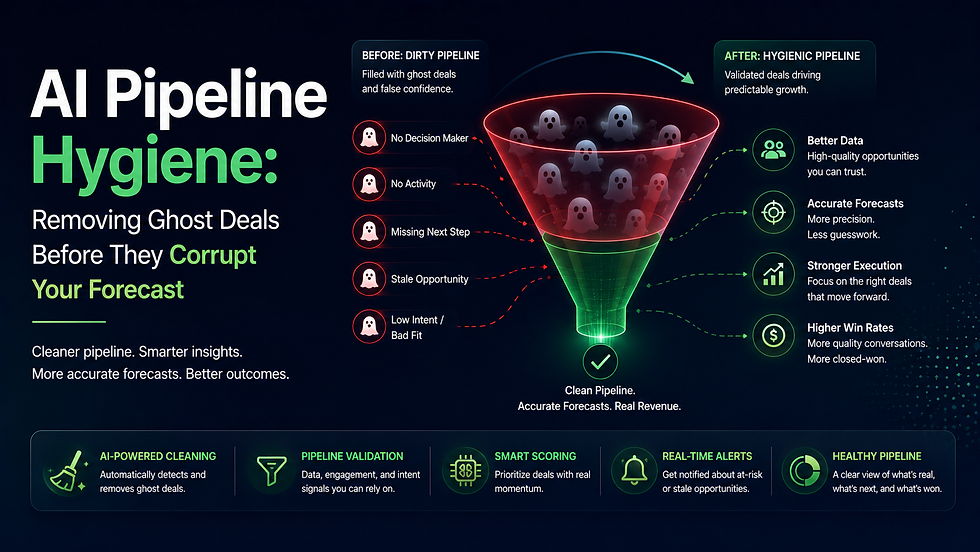
Every sales pipeline contains deals that are not real. Not in the sense of being fabricated — the companies exist, the contacts exist, the initial conversations happened. But the opportunity, the genuine prospect of a commercial outcome, has long since passed. The deal has drifted from probability into presence — it occupies space in the CRM, it appears in the forecast, it moves through stages on a schedule that reflects rep activity rather than buyer progression. It is a ghost: visible on the dashboard, invisible in reality.
Ghost deals are one of the most quietly damaging phenomena in sales operations. They inflate pipeline coverage ratios that give leadership false confidence in forecast attainability. They consume rep attention that should be directed toward genuinely active opportunities. They corrupt the pattern matching that sales analytics relies on — because a model trained on pipelines that include significant ghost deal contamination cannot reliably distinguish the signal of a real opportunity from the noise of a stale one. And when the quarter closes and the forecast proves wildly optimistic, the ghost deals are the gap that nobody adequately explains.
AI pipeline hygiene addresses this systematically. Not by asking reps to self-report deal health — they are incentivised toward optimism — but by reading the behavioural evidence of every deal and identifying which ones are exhibiting the patterns of genuine progression and which are exhibiting the patterns of quiet death.
What Makes a Deal a Ghost
Ghost deals are not created all at once. They decay into irrelevance through a process that is gradual enough to be deniable at each individual stage but unmistakable in aggregate. Understanding the decay process is essential for understanding what AI pipeline hygiene is detecting.
The Active-But-Stalled Deal
The first category of ghost deal is the opportunity that was genuinely active and has since stalled without anyone formally acknowledging the stall. A rep made contact, had positive early conversations, moved the deal into discovery or proposal stage, and then the buyer went quiet. The rep followed up twice, received one vague response, and the deal has been in the same stage for six weeks. The rep is reluctant to close it because closing it affects their pipeline coverage. The deal remains, aging, contributing to a forecast that assumes it is progressing.
AI systems identify these stalled deals through engagement decay signals: the time since the last two-way communication, the ratio of rep-initiated to buyer-initiated contact, the absence of any engagement with sent materials, and the comparison of the current silence period against the typical response cadence of deals at the same stage that eventually closed. A deal where the buyer has not initiated contact in six weeks and has not engaged with any materials in four is exhibiting a stall pattern that correlates strongly with eventual loss — regardless of what stage the CRM records it in.
The Courtesy Deal
The second category is the courtesy deal — the opportunity where the buyer is too polite to say no, or where saying no requires an internal process that is easier to avoid than complete. These deals receive responses to rep outreach, but the responses are consistently non-committal: 'still considering,' 'waiting on budget clarity,' 'need to align with the team.' The language is always reasonable. The progress is never material.
Courtesy deals are particularly insidious because they look like active engagement. The rep has recent communication to point to. The buyer has not said no. But the pattern of engagement — never advancing, always deferring, never expanding the stakeholder footprint, never requesting the materials that would signal genuine evaluation — is distinct from the pattern of a deal that is genuinely in a slow consideration phase. AI systems trained on this distinction can identify courtesy deals with significant accuracy, even when the surface signals suggest continued engagement.
The Zombie Deal
The third category is the zombie deal — an opportunity that was effectively lost months ago but has been kept technically alive through periodic rep check-ins that generate minimal buyer responses. The buyer has moved on. They may have chosen a competitor, deprioritised the initiative, had a leadership change that killed the project, or simply lost interest without making a formal decision. But the deal remains open because closing it without a formal loss creates awkwardness and affects metrics.
Zombie deals are the oldest and most clearly decayed category of ghost deal. AI identification is straightforward: time elapsed since last substantive engagement, the quality decline in buyer responses over time, and the absence of any of the behaviours that characterise an active evaluation at the deal's current stage. The system flags these deals not just as stalled but as candidates for formal closure — freeing the rep from the maintenance obligation and cleaning the pipeline of entries that should never have survived this long.
How AI Identifies Ghost Deals
Engagement Signal Analysis
The primary mechanism for ghost deal identification is engagement signal analysis — processing the full behavioural record of the deal across every channel to determine whether the engagement pattern reflects genuine buyer progression or rep-driven maintenance. AI systems assess email response latency trends (response times that are lengthening rather than shortening), content engagement (whether sent materials are being opened, read, and acted upon or ignored), meeting cadence (whether the buyer is accepting and attending meetings or finding reasons to reschedule), and stakeholder footprint (whether the internal buying coalition is growing or contracting).
These signals are assessed not in isolation but in combination — and against the historical baseline of what genuine deal progression looks like at the same stage in comparable opportunities. A deal where every individual signal is borderline may still be flagged as a ghost if the combination is consistent with the behavioural pattern of deals that subsequently closed as lost. The AI is pattern-matching against outcomes, not against arbitrary thresholds.
Stage Age Anomaly Detection
AI pipeline hygiene also monitors stage age — how long a deal has been in its current stage relative to the historical distribution of stage durations for deals that eventually closed. A deal that has been in 'proposal sent' for thirty days when the typical closed deal spent seven to ten days in this stage is exhibiting a stage age anomaly. The anomaly does not confirm the deal is dead — some legitimate deals take longer — but it triggers a deeper review of the engagement signals to determine whether the extended stage age reflects a genuinely slow evaluation or a stalled one.
Stage age anomaly detection is particularly effective at identifying deals that have been manually advanced through stages without corresponding buyer engagement — where a rep has moved a deal from discovery to proposal on the CRM while the buyer has shown no corresponding increase in engagement that would typically accompany a genuine stage transition.
Comparative Deal Scoring
The most sophisticated layer of ghost deal identification is comparative deal scoring — assessing each deal against the current engagement profile of the other active deals in the pipeline and against the historical profile of won deals at a comparable stage. Deals that score in the bottom quartile of engagement relative to the pipeline average, and whose engagement profile is most similar to deals that were eventually lost rather than won, are surfaced as highest-priority hygiene candidates regardless of their nominal stage or forecast inclusion.
What Pipeline Hygiene Produces
A pipeline cleaned of ghost deals is not a smaller pipeline. It is a more accurate one — and the difference between a large inaccurate pipeline and a smaller accurate one is commercially significant.
Forecast reliability improves — pipeline coverage ratios that were inflated by ghost deals reset to reflect genuine opportunity, producing forecasts that leadership can actually rely on
Rep attention concentrates on real opportunities — the capacity that was being consumed by ghost deal maintenance is redirected toward the deals that are actually worth working
Coaching conversations improve — managers who know which deals are genuinely active can focus their coaching on the opportunities that will determine the quarter's outcome rather than reviewing stale entries out of false conviction
Win rate data becomes more meaningful — with ghost deals removed, the ratio of genuinely contested opportunities to won deals provides a more accurate measure of the organisation's real conversion capability
AI analytics across the pipeline improves — models trained on a hygiene-maintained pipeline produce more accurate scoring and forecasting because the training data is not contaminated by the patterns of deals that should not have been in it
The Rep Relationship With Pipeline Hygiene
Pipeline hygiene has historically been a source of tension between sales leadership and reps — because closing deals without a formal loss is emotionally difficult and creates visibility into a rep's conversion rate that may be unflattering. AI changes this dynamic by making ghost deal identification objective rather than managerial. The rep is not being told by their manager that a deal looks dead. They are being shown the engagement data that the AI system has identified as inconsistent with an active opportunity.
This objectivity shifts the conversation. Rather than defending a deal against a manager's assessment, the rep can engage with the data: is the AI's reading of the engagement pattern correct, or is there context that explains the silence that does not show up in the recorded signals?
This conversation is more productive than the one it replaces — and it builds the habit of engagement-based deal assessment that improves rep judgment over time.
Conclusion
Ghost deals do not hurt the pipeline in a single dramatic moment. They erode it gradually — distorting the forecast, dispersing rep attention, and corroding the quality of the analytics that the organisation relies on to make decisions. By the time their damage is visible in the quarter's results, the opportunity to have prevented it has passed.
AI pipeline hygiene shifts this detection to the point where intervention is still possible — identifying the deals that are dying before they are dead, and giving the sales organisation the choice to act rather than simply discovering, at the close, that the numbers never added up.
A clean pipeline is not a smaller one. It is an honest one. And in sales, honesty about what is real is the foundation of every forecast that actually closes.


Comments